
Non Salvation Army Instruments
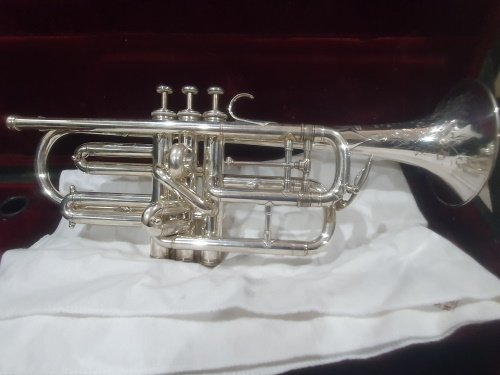
Besson Enharmonic Trumpet
In an attempt to combat intonation issues without the need for triggers, Besson introduced their Enharmonic series.
These instruments featured two sets of tuning slides on the first and second valves, one of which is slightly longer than the other. When the third valve is pressed, air is redirected through a different path in the valves, such that the longer slides are used if the first or second valve is pressed.
The design didn't take off, as the extra weight (particularly in the lower brass instruments) wasn't popular.
This Enharmonic Trumpet has been fully restored. Serial number is 99xxx.
The engraving on the bell is quite extensive. The text reads:
"CLASS A Enharmonic Patented 50 MEDALS OF HONOUR BESSON & CO Prototype 198 Euston Road LONDON ENGLAND"
An additional engraving notes this instrument was imported to Australia by Paling
"W.H.PALING & CO N.S.WALES & QUEENSLAND"
Record suggest this instrument was manufactured around around 1912.
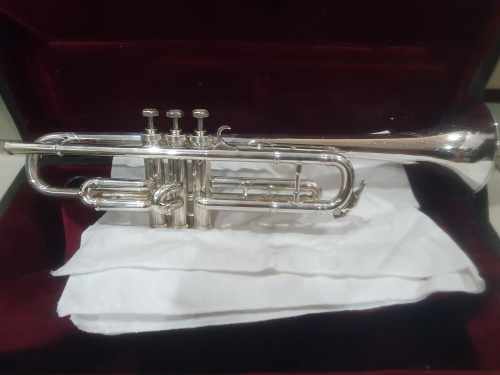
Besson International Bb/C Trumpet
This instrument is a Besson International with a tuning slide extension that can be removed to place the instrument into the key of C.
It has extensive engraving "Besson International" on the front of the bell, and the usual engraving with model and manufacturer has been placed on the underside of the bell.
This trumpet has been fully restored. Serial number is 127xxx.
The engraving on the underside of the bell reads:
"50 MEDALS OF HONOUR Besson & Co London. British Throughout Agents Chas Begg & Co Ltd New Zealand"
Record suggest this instrument was manufactured around around 1933.

Besson 5 Valve Euphonium
This is a very early Besson 5 valve Euphonium, discovered as wall art.
Remarkably, this horn plays very nicely, and has not been restored. Compression is good, and it has a very sweet sound, very different to a modern Euphonium. It is fascinated to hear what these instruments sounded like early on in their development.
The 5th valve lowers the pitch by slightly more than one semi-tone, and when used in conjunction with lower pedal notes, it corrects intonation nicely.
The engraving mentions "Chicago Bore", indicating it was part of an early attempt to break into the USA market.
There appear to be four significant attempts to solve the issue of intonation in brass instruments, caused by the fact that the difference in pipe length required to change the pitch by a semi tone is different for high notes and low notes. This was the first - an additional valve designed specifically for use on low notes to make up for the insufficient pipe length in the other valves down low. The other attempts would be the Enharmonic system, Blaikley system, and triggers.
Serial number is 58xxx.
Record indicate this instrument was manufactured in 1896.

Besson Enharmonic Baritone
This is an Enharmonic Baritone.
As per the Enharmonic Trumpet in the collection, these instruments featured two sets of tuning slides on the first and second valves, one of which is slightly longer than the other. When the third valve is pressed, air is redirected through a different path in the valves, such that the longer slides are used if the first or second valve is pressed.
Serial number is 91xxx.
Record indicate this instrument was manufactured in 1909.

Besson Enharmonic Euphonium
This is an Enharmonic Euphonium.
As per the Enharmonic Trumpet and Baritone in the collection, this instruments featured two sets of tuning slides on the first, second and third valves, one of which is slightly longer than the other. When the fourth valve is pressed, air is redirected through a different path in the valves, such that the longer slides are used if the first, second or third valve is pressed.
Unfortunately, this instrument is incomplete, and is missing a number of slides and valves. A donor instrument is required, or significant cost and time to create the missing parts. The instrument itself is in remarkable condition, so it is likely these parts have been missing for some time and the instrument has been in long term storage.
Serial number is 111xxx.
Record indicate this instrument was manufactured in 1920.

Tanabe Baritone
This is an Tanabe Baritone.
This is a Japanese instrument, but little is known about it. Tanabe trumpets are reasonably common, but there is very little about baritones.
The engraving says:
Greatest name in the World.
TANABE
(FOUNDED IN 1897)
Band Instrument Co., Ltd.
TOKYO JAPAN
Serial number is 19xxx.
Date of manufacture is unknown.